Fluent in humans.
Your child can be the smartest person in the room — and still go unheard. The difference is conversation: the skill we leave for "later," when it's hardest to learn.
The best time is the moment they start talking. That's where Wizzly lives. A voice companion your child talks with, not listens to — it learns exactly who they are and builds every story around it. What to say when a friend is crying. How to disagree without losing anyone. How to be heard.
Easy now. Nearly impossible at forty.
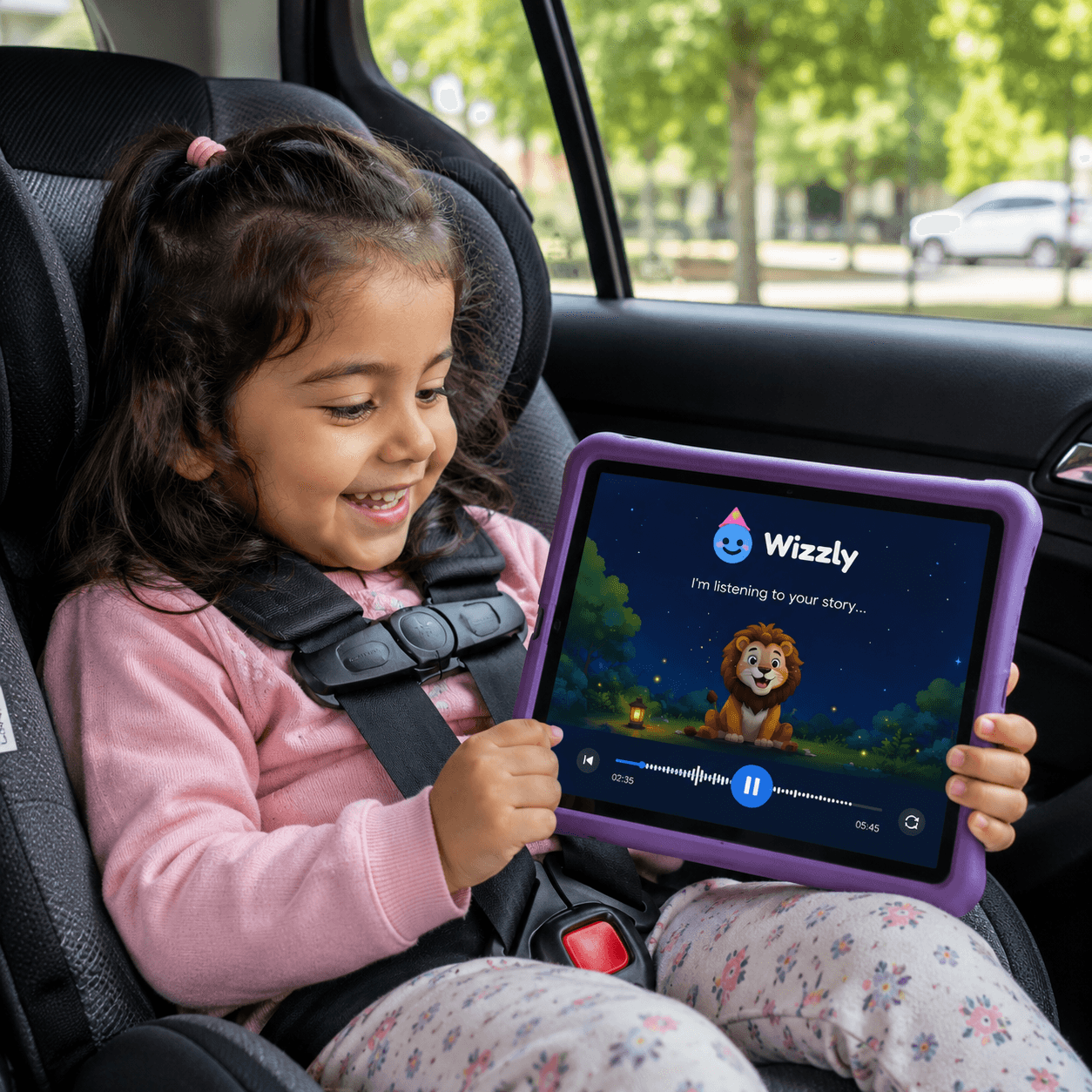
Wizzly is a voice-based AI companion that teaches children ages 3–15 conversation, emotional regulation and social skills through interactive audio stories.
Children talk with Wizzly rather than watch it, so it works screen-free — the phone can sit face-down. It is built specifically for children: one fixed character with hard content boundaries, not a general chatbot. No ads, and free during early access.
- Ages
- 3–15, in three tiers
- Format
- Voice-only. No video, no feed.
- Platform
- Runs in any browser. No download.
- Price
- Free during early access
Nobody teaches your child the thing that decides everything.
Communication and emotional skills are the strongest predictors of how a child gets on with other people, and almost nowhere in a school timetable is responsible for teaching them. Most of us picked them up late, by getting them wrong in front of people who deserved better.
Schools teach math. Apps teach coding. Tutors teach grammar. But nobody teaches your daughter what to say when her best friend stops talking to her. Nobody teaches your son how to disagree without making an enemy. Nobody teaches them how to hear what people mean, not just what they say.
We were all supposed to just pick it up. Some of us did — at 30. Some of us never did.
Meanwhile, the world flipped. AI now solves technical problems in seconds. The advantage left to our children is everything a machine can't be — the person everyone trusts, the one who finds the right words when it matters, the one who reads the silence. That's not talent. That's a language. And children absorb languages effortlessly — if someone speaks it to them early enough.
A slightly ridiculous wizard with a very serious job.
Wizzly teaches through interactive stories rather than lessons. Each story carries one hidden objective — a feeling to name, a social situation to navigate, words met in context. The child talks with a wizard, decides what happens next, and never hears about the objective.
Wizzly is a voice — warm, funny, endlessly curious — who tells your child stories and, unlike any audiobook, listens back. Your child talks, asks, interrupts, decides what happens next. Wizzly responds in real time, in the same voice, in the same story, every time.
No lessons. No quizzes. No "today we learned about empathy." If your child can tell they're being taught, we've failed. They'll just think they have a hilarious wizard friend. You'll know better. 😉
Three steps, little to no screen
Your child presses play and a wizard begins a story, then asks them what happens next. They answer out loud and the story adapts. Sessions run about ten minutes and end properly. No screen is needed once it starts.
Press play, put the phone down.
Wizzly is audio-first. Your child listens and talks — no screen required. Perfect for bedtime, car rides, quiet afternoons.
Your child shapes the story.
Every story is a real conversation. Wizzly asks, listens, adapts. Two children never hear the same adventure.
The learning stays invisible.
Each story carries a hidden skill — an emotion, a social moment, words to discover. Your child absorbs it through play.
Watch a 90-second demo 🍿
Like what you see? Play with Wizzly right now — free in your browser. 🚀
Try Wizzly Now →Native apps are on the way — until then, both badges take you straight to the web app.
One friend, from first words to big questions
Built for ages 3 to 15 — different content and a different approach for every stage.
Wizzly is built in three tiers, because a four-year-old and a thirteen-year-old need different things. Ages 3–6 covers naming feelings and turn-taking. Ages 7–10 covers friendship conflict. Ages 11–15 covers subtext, persuasion and identity.
🌤️ The Wonder Years
Short, cozy stories. Big feelings with simple names. Gentle turn-taking that builds the very first conversation muscles.
- Naming feelings — happy, sad, angry, scared, frustrated
- Turn-taking in a conversation, and waiting for an answer
- Simple apologies, and what makes one real
- Asking for help instead of melting down
- Sharing, and handling it when the answer is no
🧑🤝🧑 The Social Years
Friendship dilemmas, playground politics, first real conflicts. Stories mirror the moments your child is actually living.
- Friendship conflict — falling out, and finding the way back
- Disagreeing without escalating
- Reading tone: when "fine" does not mean fine
- Giving and taking feedback without it stinging
- Playground negotiation and group dynamics
🧠 The Depth Years
Sarcasm, subtext, identity, persuasion, the hard questions. Wizzly meets tweens and teens as an equal — and starts sparring, kindly.
- Sarcasm and subtext — what people mean versus what they say
- Persuasion, and arguing a case honestly
- Identity, and talking about who you are becoming
- Setting and holding boundaries
- Hard conversations that cannot be avoided
Wizzly doesn't just get harder. He changes how he relates — because a 4-year-old and a 14-year-old don't need a different difficulty level, they need a different friend.
Six ways we build real skills
Wizzly combines interactive stories, real spoken conversation practice, games that reinforce each skill, and a parent dashboard showing which skills are developing. Everything is voice-first and ad-free, funded by parent subscriptions rather than advertising.
📚 Stories
Interactive tales that build vocabulary and comprehension one page at a time.
💬 Conversation Practice
Real back-and-forth dialogue to build confidence speaking and listening.
📈 Progress Tracking
Parents see exactly how communication skills grow, week by week.
🧩 Games & Quizzes
Playful challenges that reinforce every lesson without feeling like homework.
🌍 Multiple Languages
Coming soonThe same social and language skills, taught across languages kids actually speak at home.
🎯 Personalized Growth Engine
Coming soonEvery story and game adapts to your child's progress report — reinforcing weak areas, stretching their strengths, and flagging parents the moment extra attention is needed.
Built by a parent. Guarded like one.
We know exactly what you're worried about, because we worried about it first.

"I learned it at 36. She'll have it at 6."
During an evening walk with my daughter (3.5 years old), we came across a little boy having a massive meltdown—screaming at the top of his lungs and hitting his parents. My daughter watched quietly, taking it all in, and then looked up at me.
"Dada, I love you. I will not hurt you, but tell me what I do when I get mad?"
I completely froze. At 36, I didn't have a good answer. The honest truth is, I’m still figuring it out myself. I still struggle to manage my own big emotions sometimes, and I still get incredibly nervous every single time I have to walk onto a stage or speak in front of a crowd.
That night, I searched online for something that could help her, but found nothing designed for a toddler's daily life. Emotional intelligence isn't something a child learns from a few counselor sessions; it has to be a part of their everday life that trains the brain over time.
I’ve spent my entire career using technology to solve complex business problems. But looking at my daughter, I realized I needed to use that exact expertise to solve a very real, heavy problem that so many parents like me are quietly facing.
Honestly, I don't care about forcing her to memorize ABCs or drill math flashcards right now. She’ll learn those basic school things eventually anyway. And let's be real—AI is going to handle all the hard math problems and technical logic by the time she grows up. The real superpower in her future is entirely human. It's knowing how to move people, how to infer what's left unspoken, and how to manage your own mind when the pressure is hitting you hard.
I wanted to make sure the things I am still sweating through and struggling to master in my 30s are tools she completely owns by the time she is 10. So, every single night after she fell asleep, I sat down in the quiet and started building Wizzly.
I didn't build this for a market. I built it because my daughter asked me a question I owed her an answer to. If you are a parent trying to navigate these huge emotions with your child too, you’re welcome to use it.
From our early access families
"She used to melt down every time she lost a game. After a few weeks with Wizzly she said "it's okay, I'll try again" — and actually meant it."
"He's started asking Wizzly follow-up questions like it's a real friend — and using the same words with us at dinner."
"The bedtime fight disappeared. Now she asks for "one more Wizzly story" instead of one more show."
Questions parents actually ask
Free for early birds
Wizzly is completely free during early access — every story, no card required.
Wizzly is early, and the families using it now are genuinely shaping what it becomes. That is worth more to us right now than their subscription.
Wizzly is live! 🎊
No waitlist, no downloads needed — Wizzly runs right in your browser. Start playing in seconds.
Try Wizzly Now →Native apps are on the way — until then, both badges take you straight to the web app.